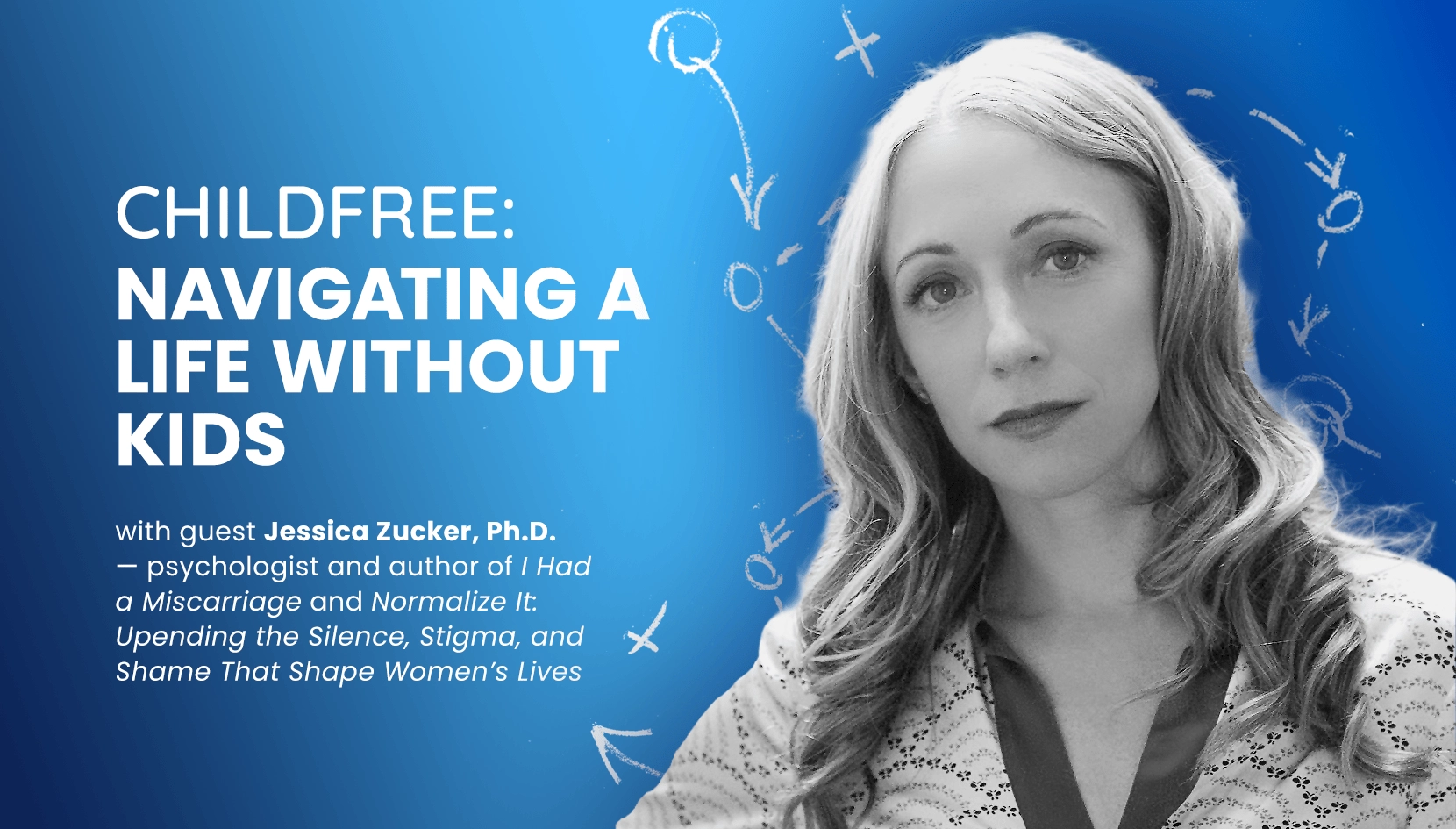


Whether you never wanted children, experienced repeated fertility loss, or decided against parenting solo, living without kids in America often means confronting a cultural wall of unsolicited advice, judgment, and expectations. In this episode of The Women’s Health Playbook, host Priya Bathija opens up about her personal journey of choosing a childfree life and sits down with Dr. Jessica Zucker, clinical psychologist, author of Normalize It and I Had a Miscarriage, and founder of the viral #IHadaMiscarriage movement. Together, they unpack the trifecta of silence, stigma, and shame that surrounds women’s reproductive decisions, how to process the non-linear waves of reproductive grief, and practical strategies for setting firm boundaries with family members who question your path.
When we decide not to have kids or we can’t have kids, there is this kind of thundering through our culture, this expectation or this disappointment.
Priya Bathija (00:19)
Whether or not to have kids is a big decision. And there are so many expectations and factors at play. Perhaps you haven’t met the right partner and you don’t want to raise kids alone. Maybe fertility treatments aren’t working and you’ve acknowledged this won’t be the path for you. Or perhaps you never wanted kids in the first place. Often women are left having to publicly defend their decision to the people around them. And privately there can be a lingering grief to sort through.
So how do you set boundaries, feel all the feelings, and get comfortable with your decision?
I’m Priya Bathija, and this is the Women’s Health Playbook. I’ve spent over two decades working to help make healthcare in America better for women. I’ve heard from women all over the country about what they’re grappling with when it comes to their health. I’ve also spent some time over the last decade getting comfortable with my own decision not to have children. And in my experience, there’s work to be done to normalize that decision in America. Especially since more and more women are deciding to stay childfree.
According to a recent study from the CDC, 39% of women in their 20s without children reported they do not expect to have kids. For women in their 30s, that number jumps to 57%. And so, in this episode, I talked to an award-winning psychologist about the reasons women decide not to have kids. The cultural trifecta of silence, stigma, and shame surrounding women’s reproductive lives.
And how to build firm boundaries with family members who judge or question your decision not to have children.
And just a note, if you aren’t childfree, think of this episode as your guide to understanding how you can support your friends and family members who are. Our coach for today is Dr. Jessica Zucker.
Dr. Jessica Zucker (02:24)
I’m a Los Angeles based psychologist and I specialize in women’s reproductive and maternal mental health and have done so for about two decades at this point.
Priya Bathija (02:35)
Prior to pursuing her PhD, Dr. Zucker worked internationally in women’s rights and reproductive health. In 2014, she gained public notoriety when she launched the I Had a Miscarriage social media campaign.
Dr. Jessica Zucker (02:49)
I was sixteen weeks into my second pregnancy when I had a miscarriage while I was home by myself and was instructed by my OBGYN how to cut the umbilical cord and promptly began to hemorrhage. It was just, you know, of course, on so many levels dramatic, traumatic and befuddling, especially from the professional personal perspective, meaning I had been specializing in this. I had been sitting with women and families for years upon years hearing about their tender stories. And I had read all the books. I had attended the conferences. I was in supervision. And I thought I knew. I knew as much as I could know theoretically. Until then I went through it and then it was a corporeal experience. My body could actually relate.
Priya Bathija (03:44)
She says part of the way she dealt with her own grief was by using her writing as a safety net. She says it became a conduit for her psychological survival and her eventual thriving in the aftermath of a miscarriage.
Dr. Jessica Zucker (03:59)
I started with a New York Times piece that launched on October fifteenth, which is designated as pregnancy and infant loss awareness day. And that’s when I started this kind of but became this viral hashtag. I really had sort of no plans of becoming somebody who was talking about this topic full time, but it underscored the ubiquity of miscarriage and the pain that can result. And this led to my first book.
Priya Bathija (04:34)
In twenty twenty one, Dr. Zucker released her book, I Had a Miscarriage, A Memoir, A Movement.
Dr. Jessica Zucker (04:41)
And then more recently in 2025, my second book, Normalize It, Upending the Silent Stigma and Shame That Shape Women’s Lives came out. And that’s sort of an expansion of my prior work, which really gets into the nitty-gritty of this cycle that I explain. This trifecta is what I call it of the silence leading to the stigma leading to the shame.
And originally in my work I was focused so much on reproductive loss, I hadn’t sort of fanned out to think about the fact that this actually applies to most aspects of girls and women’s lives.
Priya Bathija (05:25)
Although Dr. Zucker is now a mom of two, she has spent much of her career advocating for and treating women who are childless, whether by choice or due to infertility. And in this conversation, she offers up the plays you might need to hold your boundaries, to work through grief, and she offers tips on how therapy and community connection can help you feel more confident in your decision to not have children.
Thank you so much for joining us today to have this conversation about navigating a life without kids. I’m really excited to have you here and learn a little bit more about your work in the context of helping women through this phase of life of having kids, not having kids, and all that comes with it.
Dr. Jessica Zucker (06:16)
Thank you so much for having me. I’m so honored to be here and to be in conversation with you. It’s such a pleasure.
Priya Bathija (06:23)
There are so many reasons why women don’t have children. Can you share some of those reasons and what you see in your work?
Dr. Jessica Zucker (06:33)
Oh yes. I mean, that’s a big question, a very, very important one. We could talk about it for days, but yes, in my work, I’m often seeing women who are wrestling with becoming parents. So I think that, you know, unfortunately we live in a culture that has these sort of untenable expectations and assumptions that all women want to have children, usually more than one.
This gets us into trouble because where is the space? Where is the dialogue? You know, for people to really talk about the realities of women who decide not to have children. So childless by choice. Or conversely, women who have tried and tried and tried and for a number of reasons may not be able to have children or have decided to stop with, you know, the loss after loss after loss, or how prohibitive it is to, you know, spend all this money on IVF, for example. So there are so many reasons why women end up, you know, with families or don’t end up with families. And I think that we deserve a broader discussion.
And especially women who are opting not to have children, why is it that I have patients in my office who feel because of the world that we live in that they are less of a woman. And I should put that in quotes. Why do they feel like because of a choice they’re making, that they have to justify it, that they have to explain it, that they have to say, no, it’s not that I had fertility issues. It’s that I actually don’t want children. There’s an assumption that women who don’t have children don’t like children. And so I use a fictitious example in Normalize It showing the opposite of that. That of course people can like children, love children, be able to relish the joy that they bring into the world, and also choose not to have them.
You know, my point really is that it’s messier than we let it be. And it’s very, I think, important and incumbent upon us to include women’s voices who do decide to to not have children in the conversation around reproduction.
Priya Bathija (09:11)
That example that you highlighted in Normalize It. And I feel it every day because I have chosen not to have children, but I love my niece and my nephews and all the joy that they bring into my life. And I love that they are part of my life. And I get to be, in our culture, we call it Masi, like Masi to all of them and be part of them.
But for me, having children came down to a lot of factors, right? And the biggest factor was not finding the right partner to have those children with. And I think your point about opening up that conversation to talk about what are the things that are keeping women or families from having children? Because it’s not just about not finding the right spouse. It’s some of the challenges we have in our society around paid leave, around the cost of childcare, the cost of sending kids to college.
There are a lot of factors, and I appreciate that you highlighted that we should be including women who choose not to have children in this conversation. Because historically I feel like that has not been part of this conversation around pregnancy. So you mentioned silence, shame, and stigma and that trifecta. And it really does extend across the entire spectrum of women who live without children.
Why do you think society struggles so much to separate being a woman and being a mother?
Dr. Jessica Zucker (10:42)
Hmm, that’s a tough one. You know, it’s been embedded in these sort of unspoken or spoken cultural expectations from the jump, right? I mean, I think it’s just very much an antiquated view of women’s roles and women’s desires. But from a deeper psychological perspective, I think a lot of people have not even questioned whether they wanted to or not.
They felt like it was a duty. They felt like my parents did it, I have to do it, my children will do it. It wasn’t even something that was necessarily sort of reflected upon. And now I think it seems that people are actually asking the important questions and taking accountability. Who am I? What was my history like?
What was my own childhood background all about? Do I want to have to wrestle with all of those things? Right. Because being a parent requires us not to just get our children through the day. It also requires us to raise them as solid human beings that are in the world. We’ve for generations just kept on expecting people to just do it and just show up when I think we’re doing a much better job now of trying to help people understand that like not only are there choices that we can make, but that we really have to have a better understanding of what we bring to the parenting setting and therefore, you know, our limitations and and our gifts.
Priya Bathija (12:36)
Yeah. So there’s a lot of shame around childlessness, right? Whether that happens from an involuntary standpoint due to infertility or loss, or it happens voluntarily because we’ve had these conversations and made this decision to be child free. How does that shame differ or mirror each other depending on the sort of the reason a woman is child free?
Dr. Jessica Zucker (13:06)
So I think unfortunately shame is kind of simmering below the surface through our adolescence or it’s bubbling over. But then when we decide not to have kids or we can’t have kids, there is this kind of maybe it’s unspoken, but it doesn’t matter. It’s still sort of like thundering through our culture, I think this expectation or this disappointment. Why don’t you want to do this? What is wrong with you? Why can’t you secure a relationship to make this work? Or why not, oh, just do it alone? Just adopt, you know, these kinds of statements that have so little sort of thought or knowledge behind them about the financial implications or the psychological implications of these things.
So it’s hard for me to say which one yields more shame, but I think both do. And I think, you know, and mothers would say the same. Mothers feel ashamed of not quote, unquote bouncing back to their original body within four weeks of having a child. So it’s like no matter how you slice it, the shame there’s enough shame to go around for all of us throughout the lifespan, unfortunately.
Priya Bathija (14:36)
Too much shame. And one of the statements that I got was, you don’t mean that. You’ll regret it later. Yes. You should reconsider this because you don’t you don’t know what you’re talking about. And I think there’s so much shame in this process. And I love that your books just challenge that. And they say we need to have conversations and we need to come together. And I and another area you really identify where more conversation is needed is around
Grief, right? And there can be grief from loss, grief from a decision that you’ve made that no one else seems to understand.
Dr. Jessica Zucker (15:16)
Yes, and a decision you make that you feel proud of, there can be grief because your family is disappointed or people say things to you like you just, you know, shared. It’s like there can be grief in knowing what we know because others don’t necessarily approve.
Priya Bathija (15:37)
Yeah. And how do our bodies carry the weight of that greif? Whether it’s coming from repeated treatment cycles of infertility, maybe a bit of a feeling of alienation from society because the choice doesn’t align with those around us, how does that show up in our bodies?
Dr. Jessica Zucker (15:55)
I think it can take a very deep and disturbing toll, honestly. And I think that when you ask, you know, how do we carry that in our bodies, the first thought that came to mind was loneliness and feeling isolated and feeling even sometimes alienated in the context of our communities and our support systems. Because women are showing up for these appointments oftentimes alone, oftentimes you know, being needled and being, you know, blood draws and it’s just the sort of endlessness of poking and prodding can be, I wouldn’t even just say traumatizing because that’s not necessarily what it is. It’s the smalty trauma, you know, because it’s this ongoingness that really I think can take a toll and, you know, makes us really feel a heaviness or a fear or an anxiety.
That again, if there is this expectation that you’re just supposed to be bright and shiny and focus on quote, unquote silver linings and you’re gonna get through this. And if you try hard enough, it’s gonna happen. All of this can be difficult because we wanna live up to, we wanna feel the way that people are telling us, you know, that we’re going to feel. and yet we don’t.
Priya Bathija (17:23)
Yeah, what kind of tips and tools do you offer for your patients and clients that you work with when they are facing this grief and they do want to find ways to cope with it in their day-to-day life?
Dr. Jessica Zucker (17:39)
Yeah, I mean I feel like mostly what I hear is sort of how well-meaning loved ones are leaning into platitudes that are swirling through our society. And what happens oftentimes is it sends people running for the hills and it can really create fissures in deep and meaningful relationships.
I try to kind of create the space for people to be honest about how they’re feeling and to even dare themselves to lean into the pain. Because culture continues to tell us to focus on the bright side. You’re going to get through this. Just, you know, focus on the end goal. All of these phrases just work to minimize the pain. And so therapy can be a beautiful and important place for people to actually do the opposite, which is to sink into their true feelings and get away from this pressure to perform a certain thing. And to feel the shame or feel the pain or feel the rage or feel the excruciating disappointment that lives in the unknown. Because oftentimes our loved ones are saying things as if they’re psychics, as if they know what the future holds. And for the most part, no one really can. You know, reproductive endocrinologists can’t necessarily know the end point for people. And so to be able to actually muster the courage to sit with somebody in that unknown, I think is sort of a revolutionary act.
And it sounds kind of, you know, overblown maybe, but I really don’t think it is. I think the profundity of being able to not fix, not change, not, you know, focus on something that we have no idea uh, you know, we we can’t predict, and instead just being with the palpable sadness. It is beautiful and potent.
Priya Bathija (20:04)
So one of the things I’ve noticed with grief in my life is that some days it’s there and some days it feels like you’re over it and you’re moving on and you’re doing well and then all of a sudden it just comes back again. How do you approach that with clients or how do you recommend they approach it on those days where it feels like it’s all come back and all the progress you’ve made is gone?
Dr. Jessica Zucker (20:32)
Yeah. I mean it’s interesting because grief isn’t linear. So I don’t even feel like there is a sense of progress with grief. We’re not trying to get away from it. And I look at it like grief is emblematic of love and grief is, you know, part of being human. The sooner we can let that be okay, the better off we’ll be. And so, you know, I do have patients who come in so distraught that they’re feeling all the memories and all of these triggers and you know they feel like it’s day one again.
And so I try to sort of help them process it, try to find out sort of what, you know, may have um set this off, you know, what are you feeling? And also reminding them, tell me again how you felt three days ago. Three days ago, you know, everything was great. I was feeling light and airy and, you know, totally present in my life and wasn’t even thinking about the grief. Like honestly, I hadn’t and so I remind them that if that’s possible, that too will probably happen again soon, right?
So I think this circuitousness of grief is really important for people to understand. I know it’s really difficult and I know we’d rather not live in the muck and sort of the maze that that grief can be. But we really don’t have a choice. And I think the sooner that, you know, we kind of embrace that, um, the more we can help our friends and help our loved ones, help ourselves through it. Right.
Because the people who are telling us, you know, if you’ll feel better in a week, or you know, predicting the future, in my mind, it kind of reveals two things. Number one, either they’ve had difficulty allowing themselves to get into the depths of their own grief. You know, and or they’re so uncomfortable with your pain and they can’t sort of hold that like they don’t want to allow you to be in it because it makes them so uncomfortable. So they’re trying to push, push, push. Either way, those things don’t really end up in a closer connection.
Priya Bathija (23:24)
What if you have chosen to be child free and you have no grief about it? You are confident in your decision, but you’re hearing statements from people who are really important in your life saying you’re gonna regret this. How do you deal with that? How do you create the right boundaries? How do you make sure that you’re having the right conversations with those people?
Dr. Jessica Zucker (23:49)
I almost wish I could read from my book because I feel like that chapter really gets at this question in an important way. You know, I think that it’s all about boundaries. And I know that that can be a pretty overused word these days, but if it’s not your grief, why take it on? Right?
And it’s like, you know, we have course, we want the approval, we want the closeness with our family members, we want them to understand us. But there are limits to that. And those limits are oftentimes reflections of their own psychological background or makeup. Because you can find yourself explaining and explaining and explaining.
You don’t need to be the person who is teaching them that there’s a whole world of people who don’t want children and feel great about it. You know, it’s like you don’t need to necessarily be the designated educator. I mean, unless you want to be. But I think the boundaries come up when it comes to, you know, the pushing, you know, what about a cousin and what about this? And it’ll be, you know, a joy you’ve never experienced, all this stuff. And I think that, you know,
Again, it depends on the relationship and it depends on the people around you. But, you know, saying something like, I appreciate your perspective and uh I also would appreciate it if you could hear mine. And I feel really comfortable and confident in my decision. And this isn’t actually something that’s on the table for me to change. You know, so like letting people know that.
You’re not here to be convinced. No one needs to pitch you about having kids. And actually, that is exactly why I used the example in my book, that the person doesn’t have complicated feelings about it. People assume that it’s always complex, that it was a whole thing that you went through to get to this decision. And oftentimes it simply isn’t.
I think the key is to take care of oneself. And again, that can look different for everybody, but I think it’s really about trying to hold on to your truth and not kind of getting pulled into this vortex of like, ooh, did I think it through enough? Like questioning yourself. If you feel confident, if you feel comfortable, stick with that stance.
And letting people in your life know that you are joyous and fulfilled. And again, it doesn’t mean that you have to prove that in every facet of your life you are the happiest you’ve ever been, because again, that’s not life, but that you do feel very comfortable with the decision you’ve made.
Priya Bathija (27:05)
Yeah, and as you were talking through that, I was thinking through my own journey and it was reflected in that, right? At first it was judgment and shame on myself when those questions were asked. After that, it moved to, well, I gotta prove to them why my decision is right and why I am happy in every aspect of my life and no one should question it.
And now it’s kind of just, you don’t, you’re not gonna have kids. Nope. Why not? I’m good. I like my life.
And I’ve been through that whole journey. And so I love that you set forth what that looks like because it changes, it’s an evolution. And I think it takes time for us to be comfortable in the choices that we’ve made. And what I’ve seen also in these conversations I’ve had with family members and friends is that it took them time too to understand where I was coming from.
And there was that sort of messy middle awkwardness where I felt shame and they felt that they should have commentary, but now we’re all good. Like we got to a point where we have appreciated each other’s decisions and choices for our lives, but time was an important part of that.
Dr. Jessica Zucker (28:19)
Oh I think that brings up such an important point about the process. People can’t understand what they don’t understand. And so, you know, if the relationship is sturdy enough or if it means enough, you can go sort of on that journey together and hopefully arrive at a place of true understanding and empathy. And I also love how you said that, you know, now you say it more simply without a long explanation. And I think that, you know, yeah, it really reveals the place you’ve arrived. And I think that’s very profound.
Priya Bathija (28:59)
You’ve led the charge in normalizing hard conversations. What does a supportive culture look like when it comes to honoring every reproductive outcome?
Dr. Jessica Zucker (29:14)
Well, in an ideal world it looks like openness. It is embedded with empathy. And the revolutionary part would actually be like we’ve been talking about, like acknowledging what people want and why they want it without preaching, without saying, oh, you just don’t know. Once you have your own children, you’ll love them more than you’d ever imagine. We do a lot of trying to change people without taking responsibility for doing so, and it backfires.
And so I think creating a supportive culture where every type of situation can be acknowledged in its own right without it needing to be different, would allow people to shed some of this shame, would obviously squelch the silence once and for all. I mean, that’s my aim in this life. And then the stigma would just also kind of fade away because I think.
In that openness, we would find more people who relate to whatever it is we’re going through than we think there are out there. You know, we have statistics, right? We know that approximately one in four women have miscarriages. We know that approximately one in seven or one in eight people deal with fertility struggles. We know these things, but somehow the numbers don’t penetrate when it comes to our psychology.
And we still feel alone. So if we were to be having these transparent and fluid conversations, my hope is that people would actually know they were not alone. Instead of just seeing it and understanding it intellectually, they would actually feel it.
Priya Bathija (31:29)
Yeah, and I think a lot of times, at least this has been my experience, so I will just limit it to my experience. It feels that the woman who is childfree is the one that needs to do the work here, is the one that needs to start shifting the conversation, explaining her decisions. But in this theory of openness that you share, how can some of our listeners who do have kids, who do have families help support women who are child free in creating this open culture. Like, because I feel like this normalized conversation takes, takes both, right? Both.
Dr. Jessica Zucker (32:09)
Perspectives. 100%. Yes. I think it is definitely the responsibility of all parties. I don’t think that somebody who decides to do something because they don’t want to do it needs to be the one to educate everybody about themselves and everybody else who’s doing something similar. Exhausting and just not practical and not fair. Yeah, I think what that would require is for people who do have kids, for example, to be able to imagine, you know what? Why do I have to put on my neighbor, my friend, my loved one what I wanted in this life? Why do I think that because something is enjoyable or important to me, it should be for her as well? So it’s about differentiating and understanding that we can be.
Different and still be close. And we can ask questions, but we don’t want to prod. We don’t want to make it seem like there’s something darker and deeper here, and we’re gonna get to the root of it to, you know, help you understand it better. That’s not appropriate. So yeah, I think we can just assume that.
The people that we love are making decisions on their behalf that are good for them, that are informed.
Leave it and be able to relish differences and uh the fact that we’re all, you know, making different choices about our lives. And again, you know, somebody having five kids might experience grief of not, let’s say, being able to spend any time by themselves. And somebody who doesn’t have kids may experience grief of not, you know, going to birthday parties or planning all of these things or meeting people through having children.
Priya Bathija (34:14)
What are some of the things that we can do to start becoming comfortable talking about our experiences?
Dr. Jessica Zucker (34:22)
ways that we can share our stories or or even just share with ourselves. Uh and I I get into a lot of examples in my book, Normalize it, but you know, going to therapy. And I’m not just an advocate of it because I’m a psychologist myself, but it can really be a place, it’s a sacred place.
And again, of course, it’s not accessible to everybody. It’s not for everybody for various reasons, uh, too. But so therapy can be a place because it’s almost like a confessional, right? It’s like you can say whatever it is you want to say. The hope is that if you find a great therapist, you don’t feel judged, you feel held, you feel heard, you feel seen, you feel understood, and you feel helped.
And you know that that person is going to remain a life raft for as long as you need them or want them. And there’s a consistency, hopefully, in that relationship as well, which you know can be very impactful. But if that’s not of interest, I also think something that’s even easier and definitely less expensive is to write it down.
And it doesn’t need to be published and it doesn’t have to have your name on it, and it doesn’t have to be anywhere near Instagram or Facebook. It can be in a journal.
And why is that important? It’s about validating our own experience through the written word. It’s about seeing it on the page. And it’s about being able to say it all without feedback and without noise. And so, you know, that’s just one of many examples. The, you know, the journaling, the other, you know, as I said, therapy.
Priya Bathija (36:26)
Thank you so much for joining us on this episode. I learned so much and I appreciated being able to reflect on the advice that you had for women with the advice I’ve received from my therapist over the last 20 plus years. So thank you again for being with us. Thank you for writing these books. They are wonderful books, and I hope everyone who’s listening will read one or both of them because I think they’re very helpful for all of us in our journeys.
Dr. Jessica Zucker (36:53)
Thank you so much for having me.
Priya Bathija (37:00)
Thank you for listening to the Women’s Health Playbook. While our experts can’t provide you with direct patient care and medical advice, we hope that you have been armed with the resources you need and the questions you can ask your healthcare providers. We ask that you review these recommendations and reach out to your care team to discuss which approach is right for you. If you want to dive deeper into the tactics and resources we discussed today,
You can find those in the show notes for this episode. The Women’s Health Playbook is a media company focused on ensuring you have the resources, tools, and skills you need to navigate healthcare. For more plays and picks you can use to take control of your health and healthcare journey, visit us at women’s healthplaybook.com. And to join our community and get more women’s health resources sent directly to your inbox.
Subscribe to our Substack at women’s healthplaybook.substack.com. Our producer is Avery Moore Kloss. You can find her at averymoorekloss.com. I’m Priya Bathija. Catch the next episode of the Women’s Health Playbook right now in your favorite podcasting app. We hope you will share this podcast with a friend, because the more we all know, the better healthcare will be for everyone.
In this episode, we walk you through these key topics:
- The Reality of Childfree Trends: Acknowledging recent Centers for Disease Control and Prevention statistics that 39% of women in their 20s and 57% of women in their 30s without children do not expect to have them.
- The Trifecta of Silence, Stigma & Shame: How societal pressure pushes women into believing motherhood is an obligatory duty rather than an intentional choice, leading to the assumption that childfree women “dislike kids” or are “less of a woman.”
- Navigating Non-Linear Grief: Why grief—whether resulting from infertility, pregnancy loss, or the cultural friction of walking an unconventional path—is circuitous rather than a problem to be permanently solved.
- The Trap of “Bright-Siding”: Why toxic positivity, clichés, and attempts to “fix” reproductive sadness alienate people, and why holding space for painful emotions is essential.
- The Evolution of Personal Boundaries: How Bathija and Dr. Zucker view the transition from over-explaining and defending a life choice to simply stating: “I’m good. I like my life.”
- How Parents Can Support Childfree Friends: Why the burden of educating others shouldn’t fall exclusively on childfree individuals, and how loved ones can honor different life paths without unsolicited advice.
The Playbook: Actionable Boundary Plays
Dr. Zucker recommends these boundary and self-care strategies when navigating conversations about living childfree:
- The “Closed Table” Boundary Play: When family or friends push you to explain or reconsider your life plan, use a clear, calm boundary statement: “I appreciate your perspective, and I would appreciate it if you could hear mine. I feel comfortable and confident in my decision, and this isn’t on the table for discussion.”
- The “Release the Educator Role” Play: Remember that you are not obligated to serve as an educator to justify your life choices. You do not need to present an itemized argument for why your path is fulfilling.
- The Non-Linear Grief Check-In: On days when sadness, loneliness, or old memories resurface, avoid treating it as regression. Remind yourself how you felt a few days prior, acknowledging that grief naturally ebbs and flows.
- The Private Narrative Play: If you need to process complicated feelings without external advice or unsolicited opinions, put them into a private, offline journal. Writing allows you to validate your feelings clearly without filtering them through other people’s expectations.
Self-Reflection Question
“Am I constantly explaining my life decisions to seek outside permission, or am I ready to stand firmly in my own confidence without feeling the need to defend it?”
Resources & Links:
- Books by Dr. Jessica Zucker:
– Normalize It: Upending the Silence, Stigma, and Shame That Shape Women’s Lives
– Had a Miscarriage: A Memoir, a Movement - Connect with Dr. Jessica Zucker: Website | Instagram