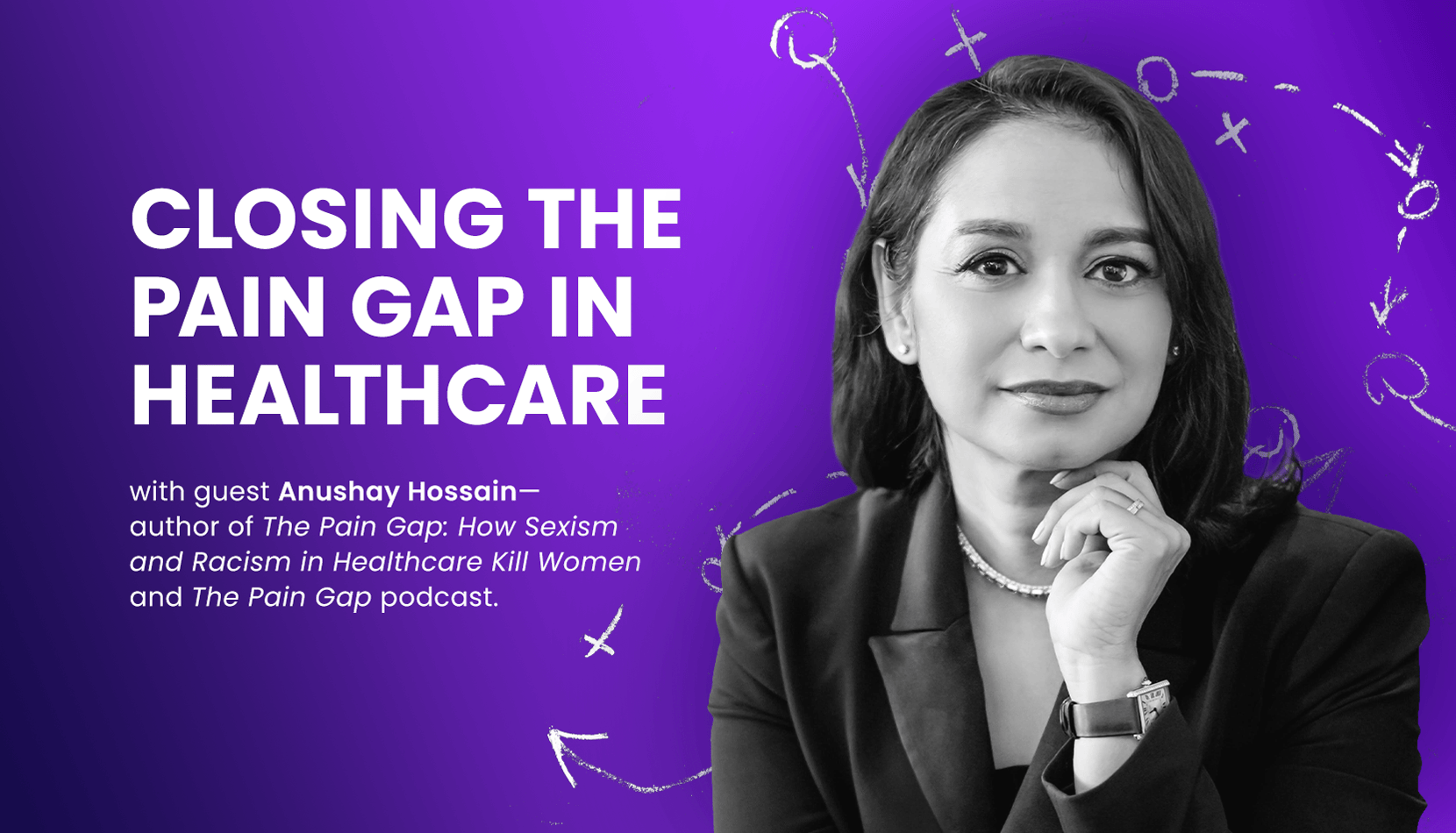


SPECIAL EPISODE 2 — When host Priya Bathija first read The Pain Gap: How Sexism and Racism in Healthcare Kill Women by Anushay Hossain during a holiday break, she found herself highlighting the jaw-dropping stats on page after page. In this powerful special episode of Priya’s Picks, Priya sits down with Anushay—author, activist, and podcast host—to explore the lethal realities of medical gaslighting and systemic bias in the U.S. healthcare system. After nearly dying during childbirth, Anushay transformed her personal trauma into a crusade to expose the “pain gap,” the “knowledge gap,” and the systemic refusal to believe women’s lived experiences. Together, they discuss why maternal mortality disproportionately impacts women of color, how to navigate doctor burnout, and why putting your own health first is an act of necessity, not selfishness.
Navigating the U.S. healthcare system as a woman means facing a lot of gaps, massive data gaps, annoying access gaps, and of course, deep knowledge gaps. And when you have to work this hard to advocate for your care, you need resources that you can trust to bridge that knowledge gap. I hope this podcast can be one of those resources for you.
But my goal is to also connect you with other resources that can arm you with the skills you need and the knowledge that many women have been historically denied.
Welcome to Priya’s Picks, a special bonus episode of the Women’s Health Playbook that will add to your bench of resources. From books to documentaries, podcasts, influencers, papers, and more, I’m gonna interview the authors, hosts, filmmakers, and creators who are helping to fill that knowledge gap.
For this pick, I need to take you back to my holiday break in 2021. I was reading a book on the couch at my parents’ house. I was in my zone. Reading, highlighting, flagging pages I wanted to come back to. At one point, my mom called over and asked me if I was reading or coloring the book. I just couldn’t stop highlighting all the data, statistics, and information that this book was feeding me.
There, of course, had been really wonderful books published before it in the women’s health space. But this one was so real, so accessible, and it included stories from women all over the country. For me, it was the first time women’s health information had been amassed within 300 easy-to-read pages. And it was also the first time I was really able to see how the systems were actively keeping women from getting good care.
My pick today should be Required Reading for Every Woman in America. Because it tackles one of those gaps in women’s health that really needs to be addressed. It’s called The Pain Gap: How Sexism and Racism in Healthcare Kill Women. And it’s written by Anushay Hossain.
Anushay Hossain (02:26)
Hi, my name is Anushay Hossain. I’m an author and podcast host of The Pink Gap.
Priya Bathija (02:32)
Okay, let’s get into it.
Anushay, thank you so much for joining us for this special episode of the Women’s Health Playbook. I am so excited to talk with you about your book, The Pain Gap, and all the work that you have done in the last five years since this has come into the world. Can you tell us a little bit more about yourself, the work that you’re doing, and why you wrote this book?
Anushay Hossain (03:10)
I wrote this book initially because I wanted to spotlight America’s maternal health crisis. After almost dying, giving birth in America in Washington, DC, in one of the best hospitals, while I was a feminist policy analyst working on lobbying on global health legislation in Washington, DC, I had no idea, even after graduating from college and living in America for two decades, that it was possible to die giving birth in America.
And then for a really long time I kept my story to myself. I really felt like it was my fault. I really did because I had never heard anybody else have a story like this in America. That experience changed my life. And I think I’m still processing the trauma of it. But the book actually ended up becoming so much more.
It became about medical gaslighting, it became about not only the pain gap, but the knowledge gap, the credibility gap, you know, our inability to believe women. We’d rather watch women die in pain than believe them or give them the benefit of the doubt. And of course, we have seen this, you know, now I feel like the pain gap is being exposed every day.
But now I think these conversations are more important than ever. Now I’m like, my goodness, women’s voices are more important than ever. You know, our stories are not only our truth, but they’re data, they’re information. It’s more important than ever that we come together to close the pain gap in women’s health because it’s getting bigger.
Priya Bathija (04:51)
Anushay, can you take a step back? You mentioned the pain gap. Can you tell us what that is and what other disparities currently exist for women in our healthcare system?
Anushay Hossain (05:06)
Well, the pain gap is the difference in how we believe, diagnose, and measure women’s pain versus men’s pain. And it’s so interesting because in every kind of disparity that I bring out in my book, it’s not just like, there’s a small discrepancy. It’s like these are really big discrepancies.
And now women have a lot of the statistics and studies to back what we’ve always known. We wait longer to be seen at the emergency room. I think that we wait 45 minutes longer than men do to be seen. We’re more likely to be dismissed mid-heart attack. You know, when we present our symptoms are very different than men. So it really became about how lethal the pain gap is and how we’re willing just to risk or give women’s lives to pay for it instead of believing women.
What is really fascinating to me, I got very obsessed with the knowledge gap while I was researching my book, because I’m just like, how do we know so little? How have women not been included in clinical trials until 1993 in America? How have we not included women in clinical trials for, I don’t know, uterine cancer, even conditions that only will affect women?
I was getting really, really kind of caught up in that. But what I think is you know just as harmful and just as dangerous is the credibility gap. How women are just not believed about our bodies, believed if we’ve been raped, believed if we’ve been sexually harassed, believed if we are dying in pain in front of you. And oftentimes society doesn’t believe women, but we’ve started not to believe ourselves. And oftentimes women don’t even believe each other.
One of the big things I call for in the book is a cultural shift. If we can just give women the benefit of the doubt, just start from there. Instead of being like, she’s lying, she’s drug seeking, or she’s dramatic, or she’s being hysterical. Like, what would happen? Because you hear these stories. You hear these stories of women being dismissed by their doctor, of women not being believed, and they’re crazy.
I mean, some of these stories, there was this feature in the Washington Post, and this woman was complaining about her migraines for six months. No one would give her a brain CT scan. Finally she got one and she had a tumor the size of a baseball in her head. Like I always want to say that you know people don’t want to believe women, but trust me, trust me, my research, my work when I say that by the time a woman has gone to the emergency room or to the doctor, she has already been suffering for God knows, you know, how long.
So then on top of everything to be dismissed. You know, I recently got diagnosed with a menstrual mood disorder with PMDD that I have been learning about so much. I’m like, how did I know so little about hormonal health and the four phases of the menstrual cycle? Why was I not taught this in high school? So I used to think like, my goodness, this is a big mess. And as long as people know and get the right information, we’re gonna fix it. Close the pain gap, close the knowledge gap, all of it. And now I’m like, my goodness, was this intentional?
Priya Bathija (08:18)
Anushay,, I’ll just say I think there’s a lot more nuance in women’s health than we have ever allowed for in our conversation. So I think we need to sort of move forward not only on conversation about these important issues, but the nuance of science and medicine around women’s health.
Anushay Hossain (08:38)
Yeah. The nuance, but also the lack of training and lack of education on physicians. I’m so grateful for the menopause and the perimenopause movement because what it’s exposed is not just the dangerous lack of information around women’s health in midlife, but once again our hormonal health, why it’s important. I can’t believe women were suffering this long.
All alone and not talking about it. But the statistic that women spend 40% of their lives in menopause and less than 20% of U.S. physicians are trained in treating menopause, that I think it’s either 65% or 85% of people, women who seek care for menopause will not get the correct treatment.
Like this is just unacceptable to me because you see the divorce rates, you see the suicide rates, and I just don’t think we can be seeing the these this in silos. And I just feel like women are supposed to and have been conditioned to just give up in midlife when I really feel like I’m having a rebirth. But now I’m like, they wanted us to be uninformed about this because it makes you so I don’t want to sound cheesy, but really powerful just because information is power, knowledge is power.
And I’m just someone that always wants to learn more. If I think I don’t know something about something, I don’t understand people who are just like, well. I’m like, where’s the curiosity?
Priya Bathija (10:11)
Yeah, so there’s one sentence in the book that has stuck with me and my work that I do on health equity, which is when something is bad for white women, it’s worse for women of color and the worst for black women. Can you explain this and how in your research you’ve seen it show up in our healthcare system?
Anushay Hossain (10:33)
Thank you for bringing up that line from my book. I believe that. It’s true. And now we have the statistics and we have the studies, which are just horrific and confirm what we have always thought, you know, it’s not race, but racism that’s driving these massive disparities. And people are usually like, well, of course there’s a difference between white women and black women in healthcare.
Yeah, but it’s massive. Black women, we hear the statistic a lot, they are three to four times more likely to die giving birth in America compared to their white counterparts. But put another way, that is two hundred and forty-three percent more likely to die. You have to ask, what is going on?
So for a long time it was these really racist stereotypes like black women are welfare queens or it’s an education issue. But now we have studies that show and find that Black women who have a college degree or higher are still five times more likely to die at giving birth than their white counterparts with a high school degree.
You know, we’ve heard about these stories with Serena Williams’ and Beyoncé almost dying giving birth in America. Serena Williams, who was not believed about her pain, she had like blood clots in her lungs. This is one of the best athletes in the world, highest paid athletes in the world. She is paid to know her body. The nurses were dismissing her, saying that, you know, she was imagining things because she was on pain medication. She ended up saving her own life.
And there’s Padma Lakshmi. It took her almost two decades to get diagnosed with endometriosis. When she finally found a surgeon that believed her, she had stage four endometriosis after being told her whole life that maybe she just has a low threshold for pain. And you know, she’s in my book and she always says, turns out I have a very high threshold for pain.
I say that in the book, but when we look at where we are today, we’re seeing women being denied life-saving abortions in hospitals, in emergency rooms. We’re seeing the politicization of women’s health, the politics of women’s health in real time.
But to bring it back to the disparities when something is bad for white women, like right now, things are bad for all women in America. They’re bad for white women too. Maternal healthcare deserts are real, healthcare deserts are real. But I think it’s such a great time to point out, yes, it’s bad for white women, but look at what’s happening to women of color.
Priya Bathija (13:10)
Hey, it’s Priya. I just wanted to pop in here and encourage you to send this episode to a friend. The information we’re sharing here is so valuable, and it’s how we help each other get the best care possible as women in America. So hit the share button on whatever app you’re listening on. Send it to your daughter, sister, aunt, mother, a coworker, or honestly, send it to every girl dad you know. Because the more we all know, the better healthcare will be for everyone. Okay.
Back to the play. You know, we’ve talked about the challenges, and in your book, you say you don’t want it to be doom and gloom, right? Because you expose all of these challenges, the disparities that exist, but you are very positive at the end of the book, and you talk about how you want it to be a motivational tool. Can you share some of the steps women can take to improve healthcare for themselves and others?
Anushay Hossain (14:12)
Yes, I definitely can. And you know, I end the book with kind of a list of things that you can do, actionable steps that you can do, even though the onus should not be on women. Unfortunately, it is on us to advocate for ourselves and to make sure we’re believed. And I think in midlife, those steps that I lay out in the book apply, just apply them like on steroids.
Do your homework. I think a lot of people expect the doctor to just be a magician. Like, bring a folder of your family history, any documents they might need. I mean, my mom went to her cardiologist and he was like, everything looks okay. And I’m like, well, this is her blood work from Bangladesh. And he was like, my goodness, this changes everything. So you have to help the doctor help you.
The book is not anti-doctor, but it is pro-advocacy. And if you can’t advocate for yourself, take somebody with you. This is something that has been repeatedly told to me when I was writing the book. And just in my years, I have seen how important it is that you have an advocate with you. I mean, you’re more likely to be believed if you bring in a male friend or like a male partner. But even if you have your girlfriend there with you, just make sure that person knows how to say, I see her in pain like this. What about XYZ?
Can you put that in writing that you don’t want to give me, you know, a CT scan that you denied this test? So those are very, very important things that you can do. and now we’re seeing you and I in midlife, like, my goodness, you might have to teach your doctor about certain things. I mean, your doctor might not believe in prescribing testosterone. You have to deal with your doctor’s beliefs, as Dr. Sharon Malone says. But when she hears a doctor say, I don’t believe in testosterone, or I don’t believe in hormone replacement therapy, she’s like, it’s not Santa Claus.
And it’s so true. It’s not optional for you to believe in science. So I think those are some really important things that you can do. Take your family history, take somebody with you who can advocate for you or on your behalf. And if you feel like your doctor doesn’t believe you or that you’re being dismissed, this is something that’s still I have to remind myself. Get another doctor.
You can change providers. I don’t know why. Even before writing my book, I used to always feel like I had to work with what I got. It’s like, no, if he doesn’t believe you, he can put you in a really dangerous lethal situation down the road. I mean, one of the big stories in the book is my own birth trauma. And one of the craziest things that happened to me.
After 33 hours of labor, three hours of pushing, you know, this baby is not coming out, and they decide to do this emergency C-section. That doctor who came in to do the emergency C-section, I will never forget this man’s face. I had never met him, I had never seen him before. He wanted me to get off the stretcher that they brought me and onto the operating table on my own. He did not believe that I was in pain.
This is after this baby is not coming out, okay? This labor is not progressing. I have a baby stuck between my legs. I have a 104 fever. I am shaking. And he didn’t believe that I couldn’t get up on my own. Finally, thank God for the nurses who were there. So someone can just say that to you. Someone can just say, I don’t believe you. And I mean, you have to prove your humanity. You might have to prove your humanity to get the health care that you need.
Priya Bathija (17:40)
Yeah. And I’m so sorry that that was the experience that you had in childbirth. It’s happening across the country. And, you know, you talk about how your book isn’t anti-doctor. And this podcast is most definitely not anti-doctor. And we actually talk about some of the challenges that doctors are facing here. And you touched on some of them, which is sort of the lack of clinical research that leads to lack of education and training.
And they’re learning a lot of this in real time, like we are. So I think your point about teaching your doctors or bringing doctors information so that they have access to the same things that you’re seeing can lead to a really nice conversation about your health and your pathway forward and help you build that relationship. And our hope, of course, is that when women show up with that information, that doctors have the time, can take the time to sit down and actually talk about it and digest it and make sense of it in real time because we’re all sort of facing that same challenge of a knowledge gap.
Anushay Hossain (18:47)
Yes. And can I just quickly say, I mean, God bless doctors in America
Priya Bathija (18:51)
Yeah.
Anushay Hossain (18:52)
Doctors are burned out. We’re talking about how the healthcare system is failing patients. It’s tough for them too. And also they only get like 10, 15 minutes. So doctors are burned out. And I think something really interesting I learned while writing the book and researching the book is view your healthcare as a team. This was really mind-blowing to me because I applied it now and it’s just so great. It’s a team effort.
But who is the most important member of that team? A lot of times people think it’s the doctor. It’s you. Don’t forget how much you know about yourself, your body, when you know something is wrong or someone’s being dismissive about something. I mean, bad doctors, doctors that don’t believe you, yeah, it happens. But can I tell you, when things go right, God bless America, okay.
I have some of the best doctors right now. I have an OB who started me on HRT before I even thought I needed it. It’s just so great. When it’s working, it’s so great. Once you have a doctor that believes you and listens to you and it becomes that kind of collaboration, it’s like being in a music studio. It’s so great. I have a GP that I found when my parents were really not well. I was managing all their health stuff. I found a GP here in Washington, DC.
You know what I told her? She’s the opposite of the pain gap. She believes you and sees you and takes what you say so beautifully and seriously. She makes me feel so seen, even when I feel like I’m just being so yappy and chatty. And we have resolved so many medical health issues, but also emotional issues.
You know, she saw me one time and she was just like, How are you? Because I was really worried about my dad, my mom doing all this stuff. And I was like, I thought it was like in a different language. I was like, what does that mean? I’m here dressed and I’m alive. My heart’s beating. But I was so burned out, exhausted. My own health was so neglected. My goodness, I had high cholesterol, I was pre-diabetic. I was at risk for alcohol-related liver disease. I was like, really? News to me. So a good doctor is life changing. A good GP is life changing.
Priya Bathija (21:20)
You know, you’re right. Like when it goes right, it is amazing. And you feel seen, you feel heard. You almost sometimes don’t know what to do with it, but that’s the way we want it to go. So what advice outside of what you’ve already given us today, do you have for women to get to that point?
Anushay Hossain (21:41)
Your health is not an inconvenience. It really isn’t. I see it so much. It came out one day just out of my mouth, but I’ve done it to myself too. It’s not. We sit with pain for so long. It could be a kidney infection. Like, what’s going on? I had a childhood friend come visit me from Bangladesh a couple of years ago. This is before my book. My God. She’s like, I have been with this pain for 16 months.
I’m like, Hemma, what are you doing? It’s incredible. Like our pain tolerance is supposed to be legendary and biblical, but then people don’t believe it when we are saying this pain is too much for me. But also how women just sit with unbearable pain, physical and metaphorical. So I really want to say to women, your health is not an inconvenience, and you can’t do all the other things you want to do, including taking care of your family, until you have your health straight.
Priya Bathija (22:38)
To your point, I’ve heard a lot of speakers in this women’s health space remind women to liken it to what you do on the plane, right? Put your mask on first before you start helping other people. And I think that’s a really important lesson that women need to learn, right? We have been trained in so many ways by the systems that we live in, not just healthcare, but just the life systems and structures that we live in.
Anushay Hossain (23:05)
Yeah, self-neglect, self-abandonment. This is a great word that I’ve learned recently that I’m like, it’s my culture. This is how I was raised. Self-abandonment was like a childhood, I don’t know, pillar for us. So I see it and I do it to myself, but now I refuse. And even though my two girls are like, Mom, stop making everything about women’s health, they just do not want to talk about women’s health. I hope when they grow up they are so serious about their health and their needs. And oftentimes there’s something so much so much deeper that’s going on.
Priya Bathija (23:43)
And I do think that those of us who are having these conversations now are opening the way for them to have better conversations in the future. And we will have more clinical research, more education, more training. And I do hope that it results in the next generations (plural) of women having more of what they need, being heard, being listened to, not being dismissed for their pain. Being able to say, I have pain and get the support that they need and having it, to your point, go right more often than it doesn’t.
Anushay, thank you so much for being with us today on the Women’s Health Playbook. And that’s a wrap on our latest episode.
Hope you enjoyed hearing more about this episode’s Priya’s Pick, The Pain Gap, How Sexism and Racism in Healthcare Kill Women by Anushay Hossain. You can find more information about Anushay’s book and where to buy it in the show notes, or on our website, women’s healthplaybook.com. And to get more women’s health resources sent right to your inbox, subscribe to our Substack at womenshealthplaybook.substack.com.
Thank you for listening to the Women’s Health Playbook. We hope this episode helps you receive better care as women in the United States. If you want to dive deeper into the tactics and resources we discussed today, you can find those in the show notes for this episode.
The Women’s Health Playbook is a media company focused on ensuring you have the resources, tools, and skills you need to navigate healthcare. For more plays and picks you can use to take control of your health and healthcare journey, visit us at womenshealthplaybook.com.
Our producer is Avery Moore Kloss. You can find her at averymoorekloss.com.
I’m Priya Bathija. Catch the next episode of the Women’s Health Playbook right now in your favorite podcasting app. We hope you will share this episode with a friend because the more we all know, the better healthcare will be for everyone.
In this episode, we walk you through these key topics:
- The Pain Gap Defined: How systemic biases cause healthcare providers to dismiss, misdiagnose, or delay treating women’s pain compared to men’s pain (e.g., waiting 45 minutes longer in emergency rooms).
- The Credibility & Knowledge Gap: The history behind why women were excluded from clinical trials until 1993, and why society regularly assumes women are “hysterical,” “dramatic,” or “drug-seeking” when reporting severe symptoms.
- Maternal Mortality & Racial Disparities: Unpacking why Black women are 243% (3 to 4 times) more likely to die in childbirth than white women, regardless of income, education, or celebrity status.
- Perimenopause, PMDD & Hormonal Literacy: How a lack of medical training around female hormones leaves millions of women navigating midlife conditions completely unassisted.
- Viewing Healthcare as a Team Effort: Why you—the patient—are the most critical member of your medical team, and how finding a collaborative clinician can change your life.
- Breaking the “Self-Abandonment” Cycle: Why women are socialized to treat their own pain as an inconvenience, and how to start putting on your own oxygen mask first.
The Playbook: “Priya’s Picks” Action Items
Anushay outlines actionable self-advocacy plays every woman should use in the exam room:
- The “Paperwork & Homework” Play: Never expect a doctor to be a magician. Organize a digital or physical folder of your medical history, recent lab work, family health history, and current symptoms before walking into the room.
- The “Wingman” Play: Whenever possible, bring a trusted friend, partner, or advocate into the exam room with you. Instruct them beforehand to confirm your symptoms and help push back if you are being dismissed.
- The “Put It in Writing” Audible: If a clinician refuses to perform a test or scan you feel is necessary (e.g., a CT scan or blood panel), ask them directly: “Can you please document in my official medical chart that you are denying this request and state the reason why?”
- The Provider Transfer Play: Remember that you are never trapped with a physician who invalidates you. If a doctor dismisses your pain or claims they “don’t believe” in evidence-based treatments (like HRT), exercise your right to find another provider immediately.
Resources:
- Book: The Pain Gap: How Sexism and Racism in Healthcare Kill Women by Anushay Hossain
- Connect with Anushay Hossain: Website | Instagram | The Pain Gap Podcast